

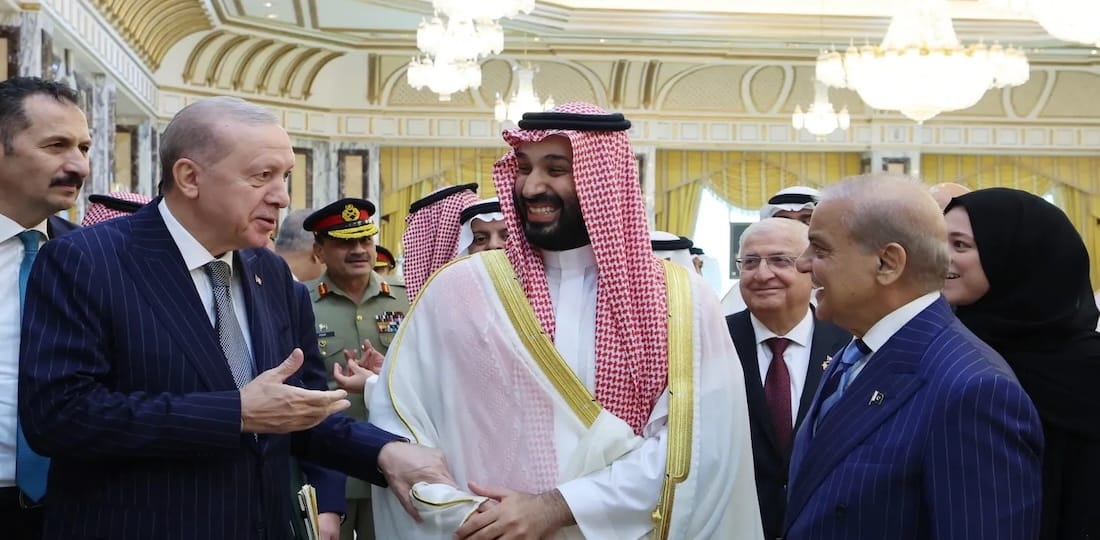
The Mecca Joint Defense Agreement, signed by Saudi Arabia, Pakistan and Türkiye, could yield geopolitical changes in the Middle Eastern security order. The trilateral agreement seems rooted in efforts to minimize security dependence on the United States and reinforce strategic autonomy. The Abraham Accords and the Mecca Agreement give way to the potential establishment of two rival blocs within their regional security architecture. This emerging new status quo, while still in early stages, will be examined through its regional context to better understand each party’s priorities.
On August 7, 2026, Saudi Crown Prince Mohammed bin Salman, Turkish President Recep Tayyip Erdogan, and Pakistani Prime Minister Shehbaz Sharif signed the Mecca Joint Defense Agreement at Al-Safa Palace. The agreement is alluded to being a result of both the Gaza war as well as the US-Israel war against Iran. While Israel’s response to October 7 is offered as its main motivation, it is the war itself against Iran and its regional repercussions that seem to have made its realization a necessity for the involved parties. Each party may contribute differently to the agreement: Saudi Arabia can provide liquidity and geopolitical clout while influencing energy exports and prices, Türkiye has a growing defense industry and NATO interoperability, while Pakistan holds nuclear military power and military experience.[1]
Interestingly, the agreement includes language similar to Article 5 of NATO in which an attack against one will be considered an attack against all members. Accordingly, the three Mecca members decide the degree, form and format of any response via consultation. Moreover, a ministerial committee and a general secretariat is being established in Saudi Arabia. The aim is twofold: to diversify security options and promote a more hands-on approach to regional security. Nevertheless, the three members do not forego their traditional and longstanding partners. The US remain very much a partner to Saudi Arabia, and especially NATO-member Türkiye, while Pakistan retains ties with China, the other Gulf states and Washington. In this sense, the Mecca Agreement is more so established as an additional security layer rather than a substitute.[2]
The implications for regional security would be numerous: first, a new security order is being established by regional players without direct western involvement, contributing thus to their strategic autonomy as middle powers; second, this entails the realization that the establishment of a hegemonic order by a regional player is not deemed feasible in the short-term and that instead these actors opt for a collective joint security initiative with room to grow; and third, the Abraham Accords signatories (Israel, Bahrain, Morocco, the United Arab Emirates and Sudan), along with states that have normalized relations with Israel, such as Egypt and Jordan, might venture to strengthen their cooperation in light of the agreement.[3]
Although the interests and threat perceptions of the three parties seem to converge, they are not one and the same. Accordingly, Saudi Arabia’s main concerns remain the Gulf and the Red Sea, especially with regard to Iran, the Houthis in Yemen and competition with the United Arab Emirates. At the same time, while Pakistan’s focus is on India, Türkiye’s is located in the Maghreb, the Balkans and South Caucasus. As a result, pragmatic shared interests might prove a defining asset for the agreement’s success and future, as ideological alignment is not a prerequisite for its signatories.[4]
Furthermore, the agreement also provides Saudi Arabia with the opportunity to diversify and boost its security and defense capabilities, offering leverage in a potential conflict with Iran and minimizing its dependence on the US. At Saudi Arabia’s underbelly, the ongoing Yemeni civil war and the fight against the Houthis – affiliated with Iran and the axis of resistance –highlight Riyadh’s imperative for recalibrating its security policy, especially when viewed through the prism of the fluctuation in the relationship with the US. By the same token, it is of note that Iran and Saudi Arabia had previously normalized relations through the mediation of China, and participate in the Shanghai Cooperation Organization, as full member and dialogue partner, respectively. Thus, the US-Israel war against Iran and its repercussions on Saudi territory have borne a negative impact on the goodwill previously established with Iran.[5]
What is more, the Mecca Agreement could operate more as a security deterrent, especially against Iran or Israel, and a tool for diplomatic coordination rather than an apparatus for joint warfare. To this end, regarding Iran and armed non-state actors, Pakistan or Türkiye would seem reluctant to attack another Muslim state, while Saudi Arabia would not be motivated to get involved in prolonged regional conflict. Thus, the agreement’s deterrence mechanism depends on five variables: commitment credibility of the members to one another with regard to their contribution; strategic autonomy, since the rationale behind the agreement is to reduce dependence on external factors; strategic ambiguity, which has been deployed in order to signal that the agreement is not directed at a particular regional player; escalation management; and operational integration consisting of joint air, missile, and maritime defense coordination. These variables would need to be in sync, since political commitment without operational integration constrains the agreement merely to symbolic signaling. Similarly, operational integration without proper management and strategic ambiguity lacking commitment might create escalation risks. [6]
Interestingly, the Mecca Agreement might impact efforts for an Israel-led regional security order, especially following the October elections, possibly by further promoting the 2020 Abraham Accords. Hence, bilaterally, there is the possibility that under US auspices, Israel, the United Arab Emirates, along with Bahrain, Sudan and Morocco, will attempt to revive and expand the Abraham Accords, undermined since the Gaza war. The accords did not include Saudi Arabia, as it had refused to join while the Palestinian question was not resolved via a two-state solution. This potential momentum would also be supported by the United States, since this architecture could serve their interests better in the region vis-à-vis China, with which both Pakistan and Saudi Arabia cultivate strong economic and political ties. If the Abraham Accords are reinitialized, the emerging regional order may consist of two blocs or groupings: the states of the Abraham Accords and those of the Mecca Agreement, with an additional potential bloc consisting of China, Russia and Iran, which claim that the United States have often undermined their sovereignty, influence and access to markets.[7]
For Israel, the Mecca Agreement reduces any diplomatic leverage that an eventual normalization with Saudi Arabia would bring through the Abraham Accords. Although the Mecca development does not imply an end to hopes for Saudi-Israeli normalization, it offers Saudi Arabia an additional strategic option and greater bargaining chips.[8]
The Mecca Agreement might also offer additional prospects for its signatories. On the one hand, if the opportunity presents itself, they may play a central role in finding a viable solution for Gaza and the West Bank. On the other hand, they might constitute a strong alternative to both Israel and Iran. However, the way the agreement will be applied in practice will play a pivotal role in relations with neighboring states. When dealing with cooperation in matters such as missile and drone defense, the military-defense industry, intelligence, maritime security, critical infrastructure and crisis management, the Mecca Agreement bears the potential for boosting regional security and standing. If adopting, however, an openly anti-Iranian, anti-Israeli, adversarial identity, it would then strike a blow to any prospects for a viable new regional security order.[9]
Interestingly, Egypt is noticeably missing from the Mecca Agreement, despite Turkish efforts to include it. This development may be attributed to the following: Saudi opposition to Egypt joining; Egypt’s own reticence regarding the success or feasibility of the agreement itself; and Egypt’s different priorities, such as its priority not to give any right relevant to its security to third parties as well as to be a possible mediator with open communication channels with all the parties; and Egypt’s hedging strategy due to its dependence on Israel for natural gas. Nonetheless, the agreement is still in process of being established and further enlarged, with future possible candidates such as Egypt or Qatar staying in the conversation.[10]
For the time being, the main concerns of these Mecca Agreement members remain the US-Israel against Iran, its regional disruptions, and the Houthi attacks against Saudi Arabia. In fact, more recently, the three signatories started cooperating in the fight against the Houthis, with Pakistan having offered and Türkiye considering an offer for defensive support to Saudi Arabia. At the same time, representatives from the three states met with Iranian officials in Tehran in an effort to de-escalate the conflict. The meeting’s agenda included the construction of a non-aggression network, the status of the Strait of Hormuz, US-Iran talks, Houthi attacks on Saudi Arabia and the US blockade of Iranian ports. Hence, the meeting may be considered as the first instance in which the Mecca Agreement members attempted to work in sync and display diplomatic coordination, as well as reassure Iran that the agreement does not target it.[11]
All links accessed on 3/11/2026.
[1] Omar Rahman, “The Mecca Joint Defense Agreement: The Makings of a New Security Architecture”, Middle East Council on Global Affairs, September 2, 2026, https://mecouncil.org/publication/the-mecca-joint-defense-agreement-the-makings-of-a-new-security-architecture/; Alia Chughtai & Marium Ali, “What are Saudi Arabia, Türkiye and Pakistan’s joint military capabilities?”, Al Jazeera, August 11, 2026, https://www.aljazeera.com/news/2026/8/11/what-are-saudi-arabia-turkiye-and-pakistans-joint-military-capabilities
[2] Rabia Akhtar, “How Impactful will the Mecca Joint Defense Agreement be Strategically? Experts React”, Harvard Kennedy School Belfer Center for Science and International Affairs, August 11, 2026, https://www.belfercenter.org/quick-take/how-impactful-will-mecca-joint-defense-agreement-be-strategically-experts-react; Ragip Soylu, “Full text of the Mecca defence pact signed by Turkey, Saudi Arabia and Pakistan”, Middle East Eye, October 20, 2026, https://www.middleeasteye.net/news/full-text-mecca-defence-pact-signed-turkey-saudi-arabia-and-pakistan
[3] Senem Duzgit Aydin, “How Impactful will the Mecca Joint Defense Agreement be Strategically? Experts React”, Harvard Kennedy School Belfer Center for Science and International Affairs, August 11, 2026, https://www.belfercenter.org/quick-take/how-impactful-will-mecca-joint-defense-agreement-be-strategically-experts-react;Giorgio Cafiero, “How Smaller GCC States Are Navigating the Mecca Defense Agreement”, Arab Center Washington DC, October 1, 2026, https://arabcenterdc.org/resource/how-smaller-gcc-states-are-navigating-the-mecca-defense-agreement/; Alex Shanahan, “Jordan’s Foreign Minister Talks Abraham Accords, U.S. Relations”, Washington Report on Middle East Affairs, October 14, 2022, https://www.wrmea.org/north-america/jordans-foreign-minister-talks-abraham-accords-u.s.-relations.html
[4] Nejat Tamzok, “The Mecca Pact: The First Test Of An Alliance With Divergent Threat Perceptions”, Eurasia Review, August 24, 2026, https://www.eurasiareview.com/24082026-the-mecca-pact-the-first-test-of-an-alliance-with-divergent-threat-perceptions-oped/; Bilal Mahli, “The Mecca Agreement: A First Step Towards a New Regional Security Architecture?”, Policy Center for the New South, August 11, 2026, https://www.policycenter.ma/publications/mecca-agreement-first-step-towards-new-regional-security-architecture
[5] Thomson Reuters, “Iran-backed Houthis attack Saudi oil facilities, injuring dozens”, CBC, September 8, 2026, https://www.cbc.ca/news/world/saudi-houthi-attacks-9.7335307
[6] Bilal Mahli, op cit.; Doga Eralp, “The Mecca Pact’s Credibility Gap”, War on the Rocks, September 9, 2026, https://warontherocks.com/the-mecca-pacts-credibility-gap/
[7] Emilio Perez Imbarguen, “Saudis must join Abraham Accords to ensure nuclear deal, Trump says”, POLITICO, July 23, 2026, https://www.politico.com/news/2026/07/23/saudi-arabia-nuclear-deal-abraham-accords-01009457;Arash M. Akhbari, “Iran, Russia, China, and the Shifting Tides in the Middle East”, The SAIS Europe Journal of Global Affairs, https://www.saisjournal.eu/article/107-Arash-M–Akbari-Iran-Russia-China-and-the-Shifting-Tides-in-the-Middle-East.cfm
[8] Steven Cook, “The U.S.-Led Middle East Order Is Over. The Mecca Agreement Proves It”, Council of Foreign Relations, August 13, 2026, https://www.cfr.org/articles/the-u-s-led-middle-east-order-is-over-the-mecca-agreement-proves-it; Rahgu Kondori, “Mecca Pact Implications for Israel and Washington”, The Times of Israel, August 8, 2026, https://blogs.timesofisrael.com/mecca-pact-implications-for-israel-and-washington/
[9] Ahmed Aboudouh, “Should Egypt join the Mecca Pact?”, Chatham House, August 14, 2026, https://www.chathamhouse.org/2026/08/should-egypt-join-mecca-pact; Akhtar Rabiaa, op cit.
[10] Faisal Edroos, “Saudi Arabia opposed Egypt’s inclusion in Mecca agreement, sources say”, Middle East Eye, August 11, 2026, https://www.middleeasteye.net/news/saudi-arabia-opposed-egypts-inclusion-mecca-agreement-sources-say; Ofir Winter, “Why Was Egypt Absent from the Mecca Agreement—and What Does This Have to Do with Peace with Israel?”, The Institute for National Security Studies, August 13, 2026, https://www.inss.org.il/social_media/why-was-egypt-absent-from-the-mecca-agreement-and-what-does-this-have-to-do-with-peace-with-israel/
[11] Alper Coşkun & Amr Hamzawy, “The Mecca Pact and the Limits of American Guarantees”, Carnegie Endowment for International Peace, October 19, 2026, https://carnegieendowment.org/emissary/2026/10/mecca-pact-us-security-guarantees; Jonathan Panikoff, “The new Middle East is modular. What the “two bloc” thesis of the region misses”, Atlantic Council, October 23, 2026, https://www.atlanticcouncil.org/content-series/the-big-story/the-new-middle-east-is-modular/; Elis Gjevori, “Mecca alliance visits Tehran in push to end Israeli-US war and build regional security”, Middle East Eye, October 26, 2026, https://www.middleeasteye.net/news/mecca-alliance-visits-tehran-push-end-israeli-us-war-and-build-regional-security; Andrew Mills, Ariba Shahid & Menna Alaaeldin, “Saudi defence pact countries push for peace in Tehran as Houthis launch more attacks”, Reuters, October 26, 2026, https://www.reuters.com/world/asia-pacific/top-officials-mecca-pact-countries-meet-iranian-officials-tehran-monday-two-2026-10-26/


