

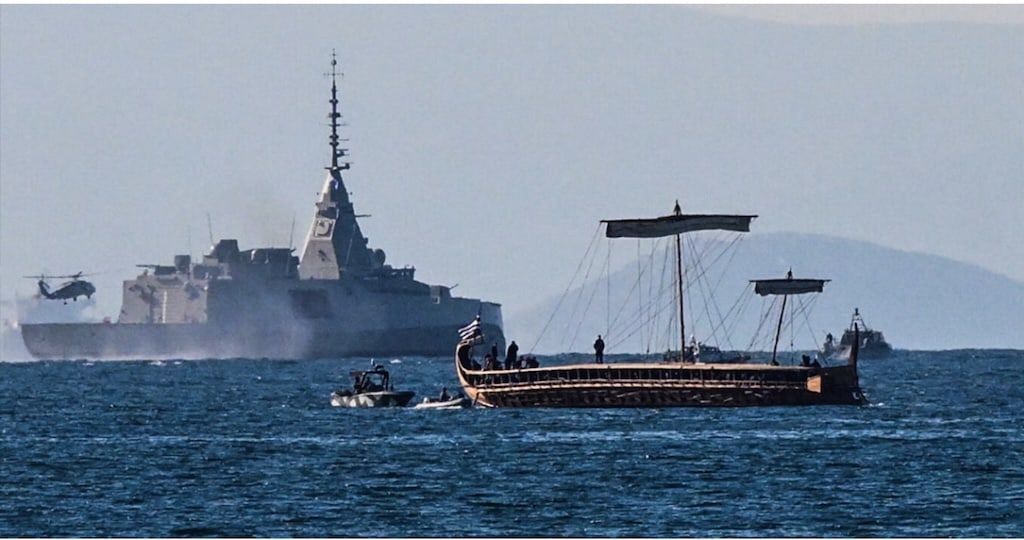
Greece’s response to the 2026 US-Israeli war on Iran has been largely shaped by fifteen years of deepening strategic partnership with Israel and the United States. While Athens officially maintains that it is not involved in any operations against Iran, the cumulative weight of its past strategic relationships strains that claim. This article examines Greece’s official position vis-à-vis the war, the ambiguities thereof, as well as its defensive mobilization since February 28.
The Evolution of the Greek-Israeli Relationship
The strategic relationship between Greece and Israel was built over the past fifteen years, driven by converging threat perceptions and mutual strategic needs. Following the deterioration of Turkish-Israeli relations in the early 2010s, Israel sought an alternative to its former strategic relationship with Turkey, which had provided valuable strategic depth. Greece, in turn, saw an opportunity based on its own economic and security interests, particularly as its threat perception of Turkey’s increasing regional activity began to converge with Israel’s. The discovery of natural gas in Israeli (2009–2010) and Cypriot (2011) waters expedited the establishment of a tripartite cooperation framework by 2012. Although energy never yielded tangible returns, cooperation spilled over into trade, tourism, and, most consequentially, defence. Joint military exercises increased, with the Israeli Air Force using Greek airspace to conduct complex training simulations, while a 2015 Status of Forces agreement allowed reciprocal military stationing. Greece made substantial purchases of Israeli-made weaponry, and Israeli defence companies acquired significant stakes in key Greek defence industries.[1]
The first serious test came during the 2023–2025 Israeli war in Gaza. Greece responded by consistently demonstrating solidarity with Israel, alongside support for a ceasefire and humanitarian language, but without condemnation. It opposed the suspension of the EU-Israel Association agreement and dismissed the ICC’s arrest warrant against Netanyahu as “a decision that solves no problem.”[2] When Israel attacked Iran in June 2025, Greece urged for de-escalation, emphasising that Iran must not be allowed to acquire nuclear weapons, without condemning the attack as a violation of international law. A part of Israel’s civil airline fleet was hosted at Athens International Airport in anticipation of Iranian retaliatory strikes.[3] On September 12, 2025, Greece was among the 142 states that voted in favour of the UN General Assembly’s “New York Declaration” on the two-state solution. However, Athens declined to recognise Palestine unilaterally, conditioning such a decision on a future UN-supervised political process, thus aligning with broad international consensus while refraining from steps that would have antagonised Israel.[4] Athens’ posture in the first ten days of the 2026 US-Israeli war on Iran would not depart significantly from the precedent set during the 12-day war.
The in limbo Greek Involvement
While Greece has not formally endorsed the US-Israeli war on Iran, its position aligns with its NATO allies. The government has called for de-escalation, respect for international law, and the need to ensure Iran does not acquire nuclear weapons. Yet, Athens has not questioned how the war began, avoiding condemning the operations of its allies as illegal under international law, instead urging Iran to refrain from attacking its neighbours —a position consistent with the initial European consensus of March 1.[5] Nevertheless, a number of facts strain the Greek position.
First, the role of the US base at Souda Bay in Crete places Greece’s claim of non-involvement under strain. The IRGC has declared that all American bases in the region within range of Iranian missiles —Souda included— constitute legitimate military targets. On February 23, the USS Gerald R. Ford docked at Souda for resupply before departing toward the area of operations. Foreign Minister Gerapetritis reiterated that Greece has deployed its advanced anti-ballistic umbrella, that the base’s role is mainly logistical and rather “unsuitable” for offensive operations, and that its operations are strictly governed by a pre-existing bilateral agreement. However, the distinction between logistical support and operational involvement is one that an adversary may ignore. Souda had already served as a logistics hub for operations against Iran in June 2025. Moreover, the base comes to the fore again as the USS Gerald R. Ford, which suffered damage from an onboard fire while operating in the Gulf, withdrew to Souda for emergency repairs.[6]
Second, the presence of a Greek Patriot battery with approximately 100 personnel in Saudi Arabia means that Greek forces are stationed inside —or at least very close— to an active theatre of war. The unit has been deployed there since 2021 with the task of protecting critical energy facilities. Since Iran began striking Saudi territory, the mission has been publicly debated in Greece by parts of the opposition as evidence of de facto involvement in the conflict. On March 19, the Greek battery intercepted two Iranian missiles, with the Greek government maintaining that the interceptions constituted a defensive action of deterrence rather than involvement. The Greek Defence Minister argued that the protection of Saudi oil installations indirectly safeguards Greek and European living standards.[7] As the war continues to escalate the risk now is not merely exposure to fire, but of deeper entanglement. The fact that Greek weapons, operated by Greek personnel have now been used against Iranian missiles, constitutes a development whose legal framing as defensive cannot fully contain its political significance.
Third, the parliamentary debate on March 4 revealed broad — albeit varied — opposition to the government’s stance vis-à-vis the war, with a cross-party consensus on the need to clarify where the threshold lies, beyond which Greece’s defensive presence becomes operational involvement. Parties across the political spectrum —from PASOK and SYRIZA to Nea Aristera (New Left) and the Communist Party— rejected any involvement in the war, with the centre-left and left characterising the US-Israeli strikes as a violation of international law and demanding that Greek bases not be used for non-NATO operations. The Communist Party argued that Greece was already involved through the infrastructure it hosts and called for the closure of all foreign bases. Criticism from the far-right focused on demands for the return of military assets stationed abroad and accusations that military deployments serve mostly allied priorities.[8]
Fourth, Greece has mobilized its defensive apparatus due to a number of developments in the war against Iran. Responding to Cypriot requests for assistance after a drone —originating from Lebanon— hit the RAF Akrotiri base on March 2, air and naval assets from Greece, France, Italy, Spain, the Netherlands, and Britain were sent to help with the island’s air defence. Greece mobilized first by sending F-16s and two frigates, including its newest flagship, while Minister of Defence Nikos Dendias visited Cyprus in a symbolic gesture. The mobilization’s coverage in the Greek press was reminiscent of the long-abandoned Greek-Cypriot Common Defence Doctrine, resulting in a positive effect on public opinion about the government’s handling during the war.[9]
Athens also reorganized its air defence map by redeploying a Patriot battery to the island of Karpathos in the southeastern Aegean. Following a request from the Bulgarian government, another Patriot battery was relocated to Greece’s border town of Didymoteicho, and two F-16s were deployed to the northeastern island of Limnos from where they will contribute to Bulgaria’s missile-defence protection.[10] The redeployment of assets from Cyprus to northern Greece prompted Turkey’s reaction. Ankara accused Athens of exploiting an international crisis to unilaterally violate the demilitarized status of Eastern Aegean islands as defined in the 1923 Treaty of Lausanne and the 1947 Paris Peace Treaty. In response, Turkey deployed F-16s to “North Cyprus” to, as Ankara stated, ensure the security of the pseudo-state “Turkish Republic of Northern Cyprus”. The exchange followed the familiar pattern of Greek-Turkish signalling, with Athens rejecting Ankara’s claims as legally baseless and reiterating the purely defensive character of Greek preparations.[11]
Greece’s official position is that it is not involved in any operation against Iran. Given that Athens has not authorised the use of its bases for offensive strikes, has not contributed forces to the coalition, and recently declined to participate in the naval mission proposed by the US President to escort vessels through the Strait of Hormuz, this position formally holds.[12] Yet, the Souda base serviced a US aircraft carrier en route to the area of operations, while a Greek Patriot battery remains stationed inside an active theatre of war. Each of these facts may be defensible in isolation, but in wartime, assessments need to take a broader view. The cumulative picture places Greece somewhat closer to the conflict than its official rhetoric may acknowledge. Greece’s strategic geography —its proximity to the Eastern Mediterranean theatre, its hosting of allied military infrastructure, its forward-deployed assets —means that the war need not necessarily come to Greece for Greece to find itself inside it.
References
All links accessed on 21/3/2026.
[1] Judah Ari Gross, “With No Landings, Israeli Jets Train for Long-Range Missions in Greece,” The Times of Israel, June 11, 2018, https://www.timesofisrael.com/with-no-landings-israeli-jets-train-for-long-range-missions-in-greece/; See also Emanuel Fabian, “Air Force Stages Major Drill in Greece Practicing Potential Long-Range Strike on Iran,” The Times of Israel, September 14, 2023, https://www.timesofisrael.com/air-force-stages-major-drill-in-greece-practicing-potential-long-range-strike-on-iran/; See also The Database of Israeli Military and Security Export, “Greece,” n.d., accessed November 19, 2025, https://dimse.info/greece/.
[2] Tony Rigopoulos, “Greece’s Risky Embrace of Israel,” Foreign Policy In Focus, August 27, 2025, https://fpif.org/greeces-risky-embrace-of-israel/.
[3] eKathimerini.com, “Israel Secretly Transferred Civilian Aircraft to Greece, Cyprus before Attack on Iran,” July 1, 2025, https://www.ekathimerini.com/politics/foreign-policy/1273977/israel-transferred-civilian-aircraft-to-greece-cyprus-just-before-attack-on-iran/; See also tovima.com, “Greece, Cyprus Step In with Call for Mideast De-Escalation,” June 15, 2025, https://www.tovima.com/politics/greece-cyprus-step-in-with-call-for-mideast-de-escalation/.
[4] Al Jazeera, “UN General Assembly backs two-state push for Israel and Palestine,” September 12, 2025, https://www.aljazeera.com/news/2025/9/12/un-general-assembly-backs-two-state-solution-for-israel-and-palestine; See also Middle East Monitor, “Greek Recognition of Palestine Would Come Only after UN-Supervised Political Process: PM,” October 16, 2025, https://www.middleeastmonitor.com/20251016-greek-recognition-of-palestine-would-come-only-after-un-supervised-political-process-pm/
[5] Hellenic Republic Ministry of Foreign Affairs, “Briefing of diplomatic correspondents by the Spokesperson of the Ministry of Foreign Affairs, Lana Zochiou, on the latest developments in Iran and the Middle East (03.03.2026),” March 3, 2026, https://www.mfa.gr/en/briefing-of-diplomatic-correspondents-by-the-spokesperson-of-the-ministry-of-foreign-affairs-lana-zochiou-on-the-latest-developments-in-iran-and-the-middle-east-03-03-2026/; See also Council of the European Union, “Statement by the High Representative on behalf of the European Union on developments in the Middle East,” March 1, 2026, https://www.consilium.europa.eu/en/press/press-releases/2026/03/01/statement-by-the-high-representative-on-behalf-of-the-european-union-on-developments-in-the-middle-east/
[6] Ajaypal Choudhary, “Iran’s Revolutionary Guards hits US Fifth Fleet in Bahrain, declares all American assets legitimate targets,” WION, February 28, 2026, https://www.wionews.com/world/israel-us-strikes-iran-irgc-hits-us-fifth-fleet-in-bahrain-declares-all-american-assets-legitimate-targets-1772277144645.; See also eKathimerini.gr, “Greece says Souda base secure, reaffirms defensive measures,” March 6, 2026 https://www.ekathimerini.com/politics/foreign-policy/1297225/greece-says-souda-base-secure-reaffirms-defensive-measures/; See also tovima.com, “U.S. Military Base on Crete Played Role in the Bombing of Iran,” June 23, 2025, https://www.tovima.com/society/u-s-military-base-on-crete-played-role-in-the-bombing-of-iran/#:~:text=Refueling%20Aircraft%20Operated%20from%20Souda,residents%20of%20Akrotiri%20and%20Apokoronas.%E2%80%9D; See also Mark Saunokonoko, “Fire damirs in Crete,” The Guardian, March 18, 2026, https://www.theguardian.com/uage, clogged toilets, and sinking morale: USS Gerald R Ford to set sail for repas-news/2026/mar/18/onboard-fire-uss-gerald-ford-aircraft-carrier
[7] Vassilis Nedos, “Greek air shield extends to Bulgaria,” eKathimerini.com, March 7, 2026, https://www.ekathimerini.com/politics/foreign-policy/1297272/greek-air-shield-extends-to-bulgaria/; See also Vicki Samara, “Μαξίμου για Patriot: Αμυντική ενέργεια και όχι εμπλοκή, η κατάρριψη ιρανικών πυραύλων στη Σ. Αραβία” [Maximou on Patriot: Defensive action and not involvement, the interception of Iranian missiles in Saudi Arabia], News247, March 19, 2026, https://www.news247.gr/politiki/maximou-gia-patriot-amintiki-energeia-kai-oxi-emploki-i-katarripsi-iranikon-piravlon-sti-s-aravia/.
[8] Vaso Delimitrou, “Πυρά της αντιπολίτευσης για την «εμπλοκή» της Ελλάδας στη Μέση Ανατολή,” [Opposition fire over Greece’s “involvement” in the Middle East], Newsit, March 4, 2026, https://www.newsit.gr/politikh/pyra-tis-antipoliteysis-gia-tin-emploki-tis-elladas-sti-mesi-anatoli-ta-dyspepta-fasolia-o-loudovikos-kai-oi-vaseis-ton-ipa/4616532/.
[9] Helena Smith, “Emmanuel Macron vows Europe will stand by Cyprus after Iran drone strike,” The Guardian, March 9, 2026, https://www.theguardian.com/world/2026/mar/09/emmanuel-macron-cyprus-europe-iran-war-drone-strike; See also Antonis Antzoletos, “Ruling ND gains ground on security concerns,” eKathimerini.com, March 12, 2026, https://www.ekathimerini.com/politics/1297771/ruling-nd-gains-ground-on-security-concerns/
[10] Vassilis Nedos, op. cit.
[11] Seyit Kurt, Gizem Nisa Demir, “Türkiye says Greece violating island status under treaties, taking advantage of regional crises,” Anadolu, March 12, 2026, https://www.aa.com.tr/en/turkiye/turkiye-says-greece-violating-island-status-under-treaties-taking-advantage-of-regional-crises/3861328; See more Manolis Kostidis, Vassilis Nedos, “Athens rebuts Turkey’s Patriot claims,” eKathimerini.com, March 13, 2026, https://www.ekathimerini.com/politics/foreign-policy/1297873/athens-rebuts-turkeys-patriot-claims/
[12] Sarah Shamim, “Strait of Hormuz: Which countries’ ships has Iran allowed safe passage to?,” Al Jazeera, March 16, 2026, https://www.aljazeera.com/economy/2026/3/16/strait-of-hormuz-which-countriess-ships-has-iran-allowed-safe-passage-to


