

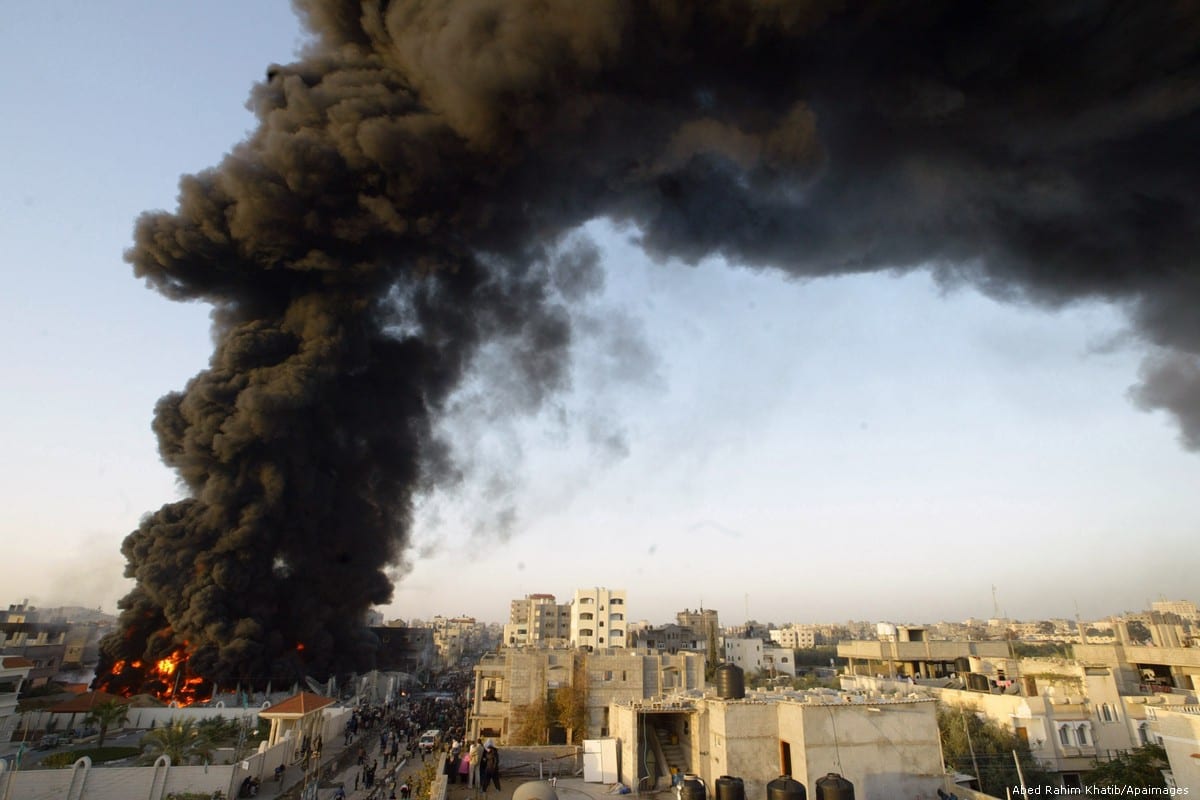
The ongoing war in Gaza is a typical case of a war that is not meant to offer any significant change to the general equilibrium of the conflict. It is a strategic World War I, an inconclusive trench war which was born out of the impasse of a truce and is destined for the stalemate of another one. It is an escalation towards a situation of limited options. Moreover, it is asymmetrical not only in terms of means and actors but also and most importantly in terms of aims: the Israeli side strives for military goals while Hamas objectives are political.
This war has been simmering since June 2008 when a limited escalation led to a six month truce. At that time the escalation did not get out of hand since no one on the powerful side represented by Israel was willing to take responsibility for pushing things towards this direction. A spiralling escalation, two years earlier, had taught Israel how poorly-thought escalations could turn unpredictable. However, the Lebanon war also resulted in the weakening of Israels deterrent which sooner or later had to be reaffirmed. In June, even the critics of postponing the inevitable were talked into delaying the operation as despite allowing Hamas to resupply herself, it would also offer some operational benefits. Precisely, the relative peace would induce Hamas to open up its presence to the Israeli intelligence which could thus produce a fuller operational map for when the operation materializes.
Few months later the necessary missing component appeared as Olmerts last hopes of recuperating vanished into thin air. At the same time as elections were anticipated, the Foreign Minister (and Kadimas new leader) Tzipi Livni and the Minister of Defense (and Labours leader) Ehud Barak both realized that the kneeling of Hamas or the achievement of a better security balance in the South could be of great benefit on their standing vis-a-vis Netanyahu in the forthcoming elections. The latter that was on the safe side as he enjoyed minimal electoral risk, was able to blackmail both Kadima and Labour into action. Against this background, the first step towards escalation was undertaken on November 4, when Israel overreacted to suspicious movements near the fence, resulting in the killing of six members of the Qassam Brigades.
Hamas accepted the challenge by allowing rocket-firing to resume. During the months of truce, Hamas had managed to keep things quiet and more or less enforced the truce. Particularly, it could show to all those who were displeased by its decision to enter into an agreement with Israel, that Hamas was the one in charge, as any signs of defiance (the Army of Islam, the Darmush family and Fatah cadres) were suppressed. This respite from Israeli counter-insurgency besides reaffirming Hamas political primacy also allowed the expansion and upgrade of its arsenal. However, as the siege remained in place it looked like as if the truce benefited only Hamas. Hence, it had two options. The first one was to opt for its short term preservation. However this option would bring about the gradual erosion of its public image and its edge over other operating groups. The second option was to escalate the conflict in order to get a better agreement.
Although both parties shared an incentive for escalation, after the first skirmishes had occurred the decision for further escalation was on Israels side due to Hamas geographical restriction and its limited possession of military options. The Cast Lead Operation was inaugurated with a massive air bombardment which, based on extensive intelligence, rendered only a matter of days to level the infrastructure attributed to Hamas as government and as movement while skyrocketing the number of victims (at the time of writing already more than a thousand). At that moment Israels tactical victory was undisputed. However, the tactical gains were far from being translated into an operational (more so a strategic) victory. Tel Aviv reached that critical moment where air bombing touches its culminating point and presents diminishing returns. The Israelis could either wind the operation down in assuming that this would have assured them a better bargaining position to conclude an ameliorated agreement (which was not apparent) or introduce ground forces to finish off what the IAF had already done in order to build up pressure on Hamas.
Livni and Barak opted for the first option suggesting a turn to diplomacy as the risk for both was getting higher. The only one free from these demurs was Olmert who perceived the advocating of further escalation as his last chance to clean up his name without risking to be the one to clean up the mess of a failure. The rocket landing in Beersheva (31/12/08) which further embarrassed the supposed gains came to Olmerts aid. As the Palestinian rocket-firing capability – although impaired – was not eliminated and consequently the security situation in the southern part of the country did not improve adequately while Hamas was not forced to accept a reformulated agreement, the use of ground forces seemed unavoidable. In the first days of the ground operation the IDF managed to retain the initiative in Israeli hands as the running out of targets for the IAF was compensated by manoeuvres in the open areas close to the border which were secured with limited losses. At that point, Israel reached a strategic stalemate despite its decision to expand the ground operations by slowly engaging urban areas. The latter decision is merely an attempt to avoid holding fixed positions and turning the troops into sitting ducks for the Hamas operatives while the political leadership tries to decide on the extent of the strategic objectives of the war and the available military options.
Given the pace and the precautions, the Israeli troops are able to advance with relatively low losses and to induce although not eliminate the movement completely – a significant setback in Hamas power projection but unless the ground operation is envisioned to be a short-term sweeping up with minimal long-term results, it is pointless. It does not matter whether Israels aim is merely to eliminate the rocket threat or to re-establish control over only the Gaza-Egypt border area (Philadelphi corridor) in order to diminish Hamas resupply rate, in the end it will have to re-occupy large parts of Gaza. In the first case the reason is obvious as the portability, low-technology and increasing range of the rockets requires minimal space and time for their use. In the second case, re-occupying the border will not only strain the relations with Egypt but will also present operational difficulties since this control zone would offer a perfect nearby target for Palestinian attacks and thus would require a protection force for the stationed troops which for the same reasons mentioned above would gradually have to expand the range of its protection mandate. As the return to the pre-withdrawal situation is the least wanted option among Israeli decision-makers, the only one left is a temporary occupation which after smashing Hamas would pass the responsibility to other players. The possible candidates would be on the one hand an international force and on the other hand the forces of the Palestinian Authority (Fatah).
Regarding the first option, Israel is highly sceptical as it considers international forces both as, too soft to deal with the possible security challenges Hamas is able to pose and as an obstacle for new operations. Fatah forces are perceived as more promising from Tel Avivs perspective; however, the last thing Fatah wishes for is to return to Gaza on an Israeli tank. Due to Abbas decreased popularity among the Palestinian community Fatah has no other option than to enter into national unity talks with Hamas, if it wants to exercise any kind of power in Gaza. In any case this move would also be a face-saving gesture for Abbas, who at the beginning of the war directed more criticism to Hamas than Israel (only later he felt obliged to re-balance the emphasis of his accusations) and cracked down on demonstrations in the West Bank. Additionally, he has to deal with a frail legitimacy which derives not only from the expiration of his presidential mandate (January 9) but which is also based on a lack of trust from within his movement. The relationship between Abbas and his former chief negotiator Ahmed Qurei (quite influential in Fatah) is characterized as being bad. Furthermore the empowerment of cadres thought to be close to Barghouti in the regional elections put Abbas into a shaky position to withstand highly controversial moves against Hamas hand-in-hand with Israel.
Although Hamas has not been as successful as Hezbollah it has fared relatively well so far. It has managed to survive through the most asymmetric and unfavorable part of the conflict while sustaining minimal losses (in high rank cadres) and keeping almost intact its Control & Command communications as well as its ability to project itself favourably via various communication channels. Moreover, Hamas managed to preserve the civil order while moving its military capabilities underground, deployed in a rather favourable urban environment waiting to ambush the approaching troops. Nonetheless, so far, on the military level it failed to demonstrate Hezbollahs prowess and thus it failed to inflict direct inhibitory- costs on Israel except its resilience and tenacity to remain a constant nuisance. Some Hamas members have suggested that getting rid of the government impediments and going underground, will offer bigger freedom of action and a more clear-cut strategy. However, it will also involve less control of factors beyond the organization itself (including the manipulation of its own image). In any case, Hamas most pressing issue is not so much to defeat Israel militarily but to upgrade its international position. This can only be achieved by the preservation of its political presence. Moreover, continued suffering of the Gazans while Hamas is digging deeper underground will at some point re-direct the accusations from Israel to Hamas. Under this light, the continuation of the war conflicts with Hamas interests. This situation of strategic stalemate makes an exit strategy essential for both actors. As no visible breakthrough has been achieved the only option left will be a new truce agreement.
Efforts to this direction have already been undertaken by Egypt (the only Arab country urgently in need of bringing about a cessation to the crisis), France and Turkey (the new regional mediation guru) while the US like usual has kept a wait and see stance. Publicly it supported Israel; however, this time the U.S. who always makes use of their power of veto when it comes to resolutions against Israel abstained from voting on the UN Resolution on Gaza (a policy differentiation with no immediate impact but possibly important future implications). Middle Eastern reactions were restricted to the usual lip service to the Palestinian cause and blame exchange. The Arab League convened several days after the war had started and its sessions were monopolized by disagreements about the identification of the culprit who could be blamed for the entire current situation. Some blamed Israel exclusively while others Israel and Hamas together. Even the two states closest to Hamas: Syria and Iran, tried not to over-react. Syria kept a low profile condemning Israels aggression, carefully though, not to undermine the progress on the Israeli-Syrian track. Additionally, Damascus refrained from accusing the Arab regimes of inaction, like in 2006, since it wanted to preserve the momentum for the warming up of their relations. Finally, Iran staged the regions most impressive symbolic justification of remaining inactive. Students attacked the British embassy and threatened to occupy the Egyptian and Jordanian one. Tens of thousands of Iranians volunteered to join the Gaza struggle as suicide fighters. In both cases, however, Tehran knew very well when to pull back the strings and propose instead a “mental and political jihad against the enemy”. Not directly involved in the initiation of the war and isolated diplomatically, Iran and Syria are not able to have any immediate impact on its termination while a long-term impact pre-supposes that their issues with Israel are addressed.
In the light of the strategic impasse and the limited regional push for a diplomatic breakthrough any truce seems unlikely to involve anything more than a problematic agreement on the Rafah crossing. Israel would be pleased if an international force along with the Egyptian troops monitored the border. However, the Egyptians have clearly stated that on their side of the border there is the need for nothing more than an increased technical assistance and that the crossing would open only if PA controlled the other side. At the same time, Hamas repeatedly stated that it would accept international or PA presence only if there was a guaranteed role for the movement itself. At the intersection of these two positions lays the most possible agreement. Israel could consent to such an agreement given that some international and PA control is better than Egypt’s lack of control and in any case it reintroduces Fatah into Gaza. For Hamas to accept, an elevation of its role and most importantly a direct or indirect international recognition are required. Second but equally important, Fatah will have to pay for its return by making concessions on the presidential election issue, loosen its grip on Hamas in the West Bank and release several imprisoned Hamas members. After all, the main aim of Hamas is not to rule the Gaza Strip but to rule the West Bank. This is the real heart of the Palestinian issue.
In any case whether this scenario comes true or not, at this point it seems doubtful that this conflict can go beyond its trench-war phase. Unless an internal or external dynamic alters this peculiar asymmetric- equilibrium in Palestinian/Israeli relations and pushes the strategic pendulum to a decisive point, they will have to operate in a bloody stalemate.


